Data for models that
imagine what happens next.
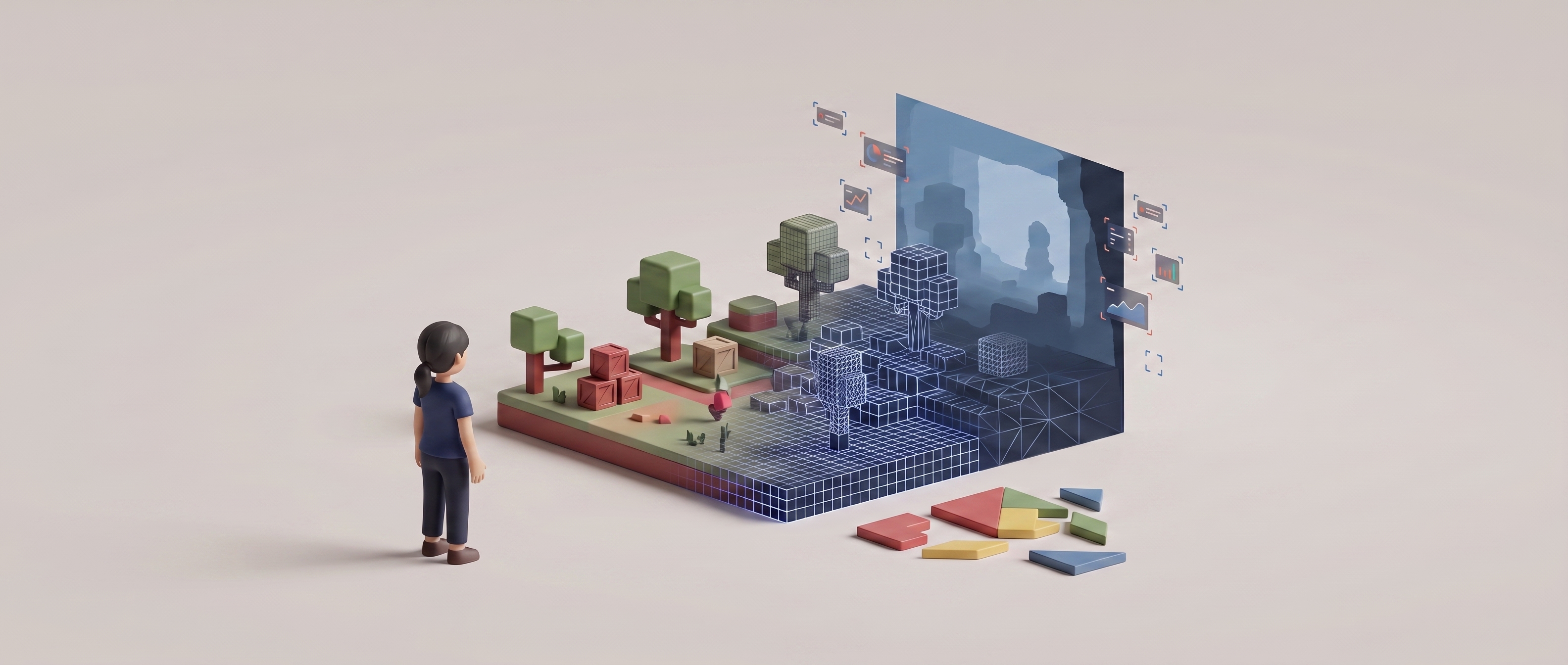
Training data for world models — gameplay video paired with the ground truth behind it: 4D geometry, tick-level world state, and human-written visual reasoning.
The four product lines below are live, browsable samples packaged in the format we ship in production. Together they cover the loop a world model has to learn: watch the world move (4D game capture), read the state that produced every frame (engine-native logs), reason about what it sees (chain-of-thought visual and STEM data), and build the objects its worlds are made of (parametric 3D assets). Nothing is estimated by an off-the-shelf perception model — depth, pose, state and events are read straight from the engine, and reasoning chains are written by people.
tidelaccess
4D game capture with real telemetry
Gameplay video from a proprietary capture pipeline over AAA titles, paired with the ground truth a world model actually needs — measured from the engine, not estimated by a perception model.
4D Game Capture
Three browsable categories — A · Action + Camera, B · 4D + Depth, C · Multi-Camera — every frame with real telemetry on one timeline.
Custom capture runs
Title / genre mixes, camera rigs, action distributions and episode lengths captured to order on the same pipeline — engine as generator and evaluator for your model's predictions.
Engine-native world state
Every video frame ships with the exact world state the simulation computed at that instant — entities, components, events. Nothing is detected; everything is read. One 60 Hz clock across all modalities.
Tick-aligned state inspector
Episode ep001 in a live inspector: video with SEG / DEPTH / BBOX overlays, pixel→state decoding, and a per-tick world-state bar.
Action → consequence replay
The same engine data replayed as causal chains — shooter, target, health drop, impact, elimination — assembled step by step over the video.
Visual reasoning with human chains of thought
The seeing skills frontier models still fail — on the BabyVision benchmark (arXiv:2601.06521) adults score 94.1% while the best model scores 49.7% — and the reasoning-first data that trains them.
BabyVision picture puzzles
Counting, find-the-difference, mazes, shadow matching, pattern logic — every sample with a human-written, step-checkable chain of thought.
K12 STEM with diagrams
High-school Math / Physics / Biology diagram problems, LaTeX-typeset, with verifiable answers and worked solutions.
Parametric 3D objects for the worlds themselves
Simulation-ready objects generated by build scripts: change a dimension, rerun, and the mesh, UVs, PBR textures and renders all regenerate consistently. Real-world scale, named movable parts, and the editable Blender source with every piece.
Parametric 3D Objects
Forty objects across furniture, porcelain, lighting, appliances, props, vehicles and full rooms: rotate the live GLB in the browser, play the turntable, operate the movable parts.
Custom object sets
Categories, parameter ranges, variant counts and material sets built to order on the same pipeline — the same six elements on every object.